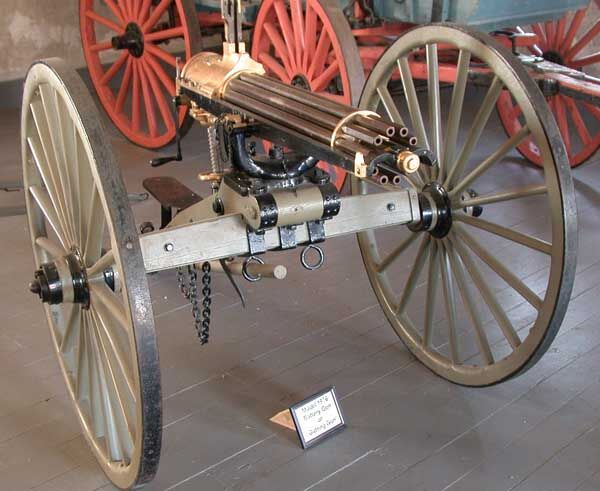
1893 45-70 Calibre Gatling Gun


The Gatling gun is a rapid-firing multiple-barrel firearm invented in 1861 by Richard Jordan Gatling. It is an early machine gun and a forerunner of the modern electric motor-driven rotary guns and rotary cannons.
The Gatling gun's operation centered on a cyclic multi-barrel design which facilitated cooling and synchronized the firing-reloading sequence. As the handwheel is cranked, the barrels rotate clockwise and each barrel sequentially loads a single round of cartridge from a top-mounted magazine, fires off the shot when it reaches a set position (usually at 4 o'clock), then ejects the spent casing out of the left side at the bottom, after which the barrel is empty and allowed to cool until rotated back to the top position and gravity-fed another new round. This configuration eliminated the need for a single reciprocating bolt design and allowed higher rates of fire to be achieved without the barrels overheating quickly.
One of the best-known early rapid-fire firearms, the Gatling gun saw occasional use by the Union forces during the American Civil War, which was the first time it was employed in combat. It was later used in numerous military conflicts, including the Boshin War, the Anglo-Zulu War and the assault on San Juan Hill during the Spanish–American War.[4] It was also used by the Pennsylvania militia in episodes of the Great Railroad Strike of 1877, specifically in Pittsburgh. Gatling guns were even mounted aboard ships.
By 1893, the Gatling was adapted to take the new .30 Army smokeless cartridge. The new M1893 guns featured six barrels, later increased to ten barrels, and were capable of a maximum (initial) rate of fire of 800–900 rounds per minute, though 600 rpm was recommended for continuous fire.[3][6] Dr. Gatling later used examples of the M1893 powered by electric motor and belt to drive the crank.[7] Tests demonstrated the electric Gatling could fire bursts of up to 1,500 rpm.
The M1893, with minor revisions, became the M1895, and 94 guns were produced for the U.S. Army by Colt. Four M1895 Gatlings under Lt. John H. Parker saw considerable combat during the Santiago campaign in Cuba in 1898. The M1895 was designed to accept only the Bruce feeder. All previous models were unpainted, but the M1895 was painted olive drab (O.D.) green, with some parts left blued.